


Jasmine, an essential ingredient in many perfumes, grows in abundance around the Egyptian village of Shubra Beloula, which is responsible for much of the world’s production.
When it comes to perfume, most people instantly think of famous French labels such as Chanel N°5, Miss Dior, Yves Saint Lauren’s Opium and Guerlain’s Shalimar. However, likely few would know that an essential ingredient in many of these iconic brands likely hails from a small village in Egypt.
Shubra Beloula El-Sakhaweya, located about 97km north of Cairo and simply referred to as Shubra Beloula, is responsible for more than half of the world’s production of jasmine. These blossoms yield a classic feminine floral scent found in many perfumes, making jasmine a “foundation stone in perfumery”.
“We have reached up to 2,500 tonnes of blossoms processed per year or per season. And that accounts for about 60% plus or minus of the world production,” said Hussein A Fakhry, owner of the leading jasmine extraction factory in Egypt and head of the executive committee of the International Federation of Essential Oils and Aroma Trades (IFEAT).
“Shubra Beloula has the highest density of production [in Egypt]… take a compass, you put your point on Shubra Beloula and then you draw a circle of about [a] 30km radius. And this is where all of Egypt’s jasmine is coming from,” continued Fakhry, whose father introduced jasmine planting to the village in the 1950s.
Most of Shubra Beloula’s land, around 257 acres, is planted with jasmine, with a few farms cultivating an another aromatic tree called bitter orange. Jasmine fields are divided into rows, and when the flowers bloom at night, they give off an intense pungent exotic scent. Villagers like talking with the few visitors who traverse the town’s unpaved roads about the beautiful flowers that surround them, and might even invite them to help with picking process.
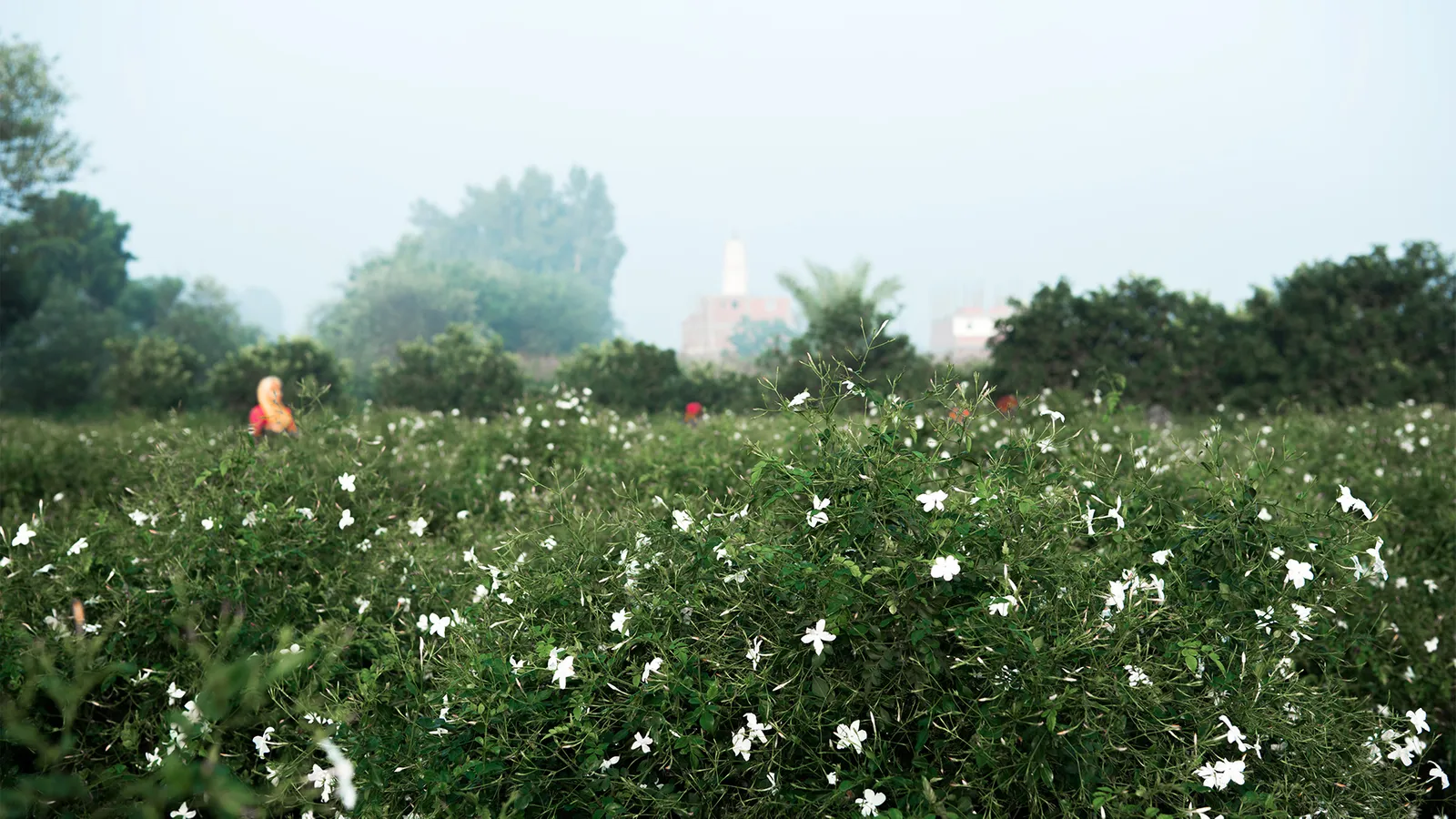
For villagers, jasmine is not just a nice smelling flower but a major source of their livelihood. “Everyone in this village from the eldest to the youngest picks jasmine flowers,” said jasmine picker Mohamed Faraj. “Kids as young as seven years old wake up by dawn, pick jasmine for a few hours then head to school. I used to do so since I was nine years old.”
Jasmine harvesting, which occurs from June to December, is a unique and fascinating process. Every day before sunset, jasmine fields look and smell like just any other green area with just few blossoms showing here and there. Yet, only a few hours later, the mature buds fully open and their fragrance spreads across the fields inviting the villagers to head into the darkness to collect them.
“People start picking at dawn [03:00] to around 09:00, because after sunrise, unpicked blossoms lose their essence and become unusable,” Faraj said.
“The plant is the queen of the night. It has basically adapted its biology to being pollinated by night insects like moths rather than bees and birds, which are basically active during the day,” Fakhry explained. “The blossoms open during the night and send out their best fragrance. So, you want to pick it at that moment.”
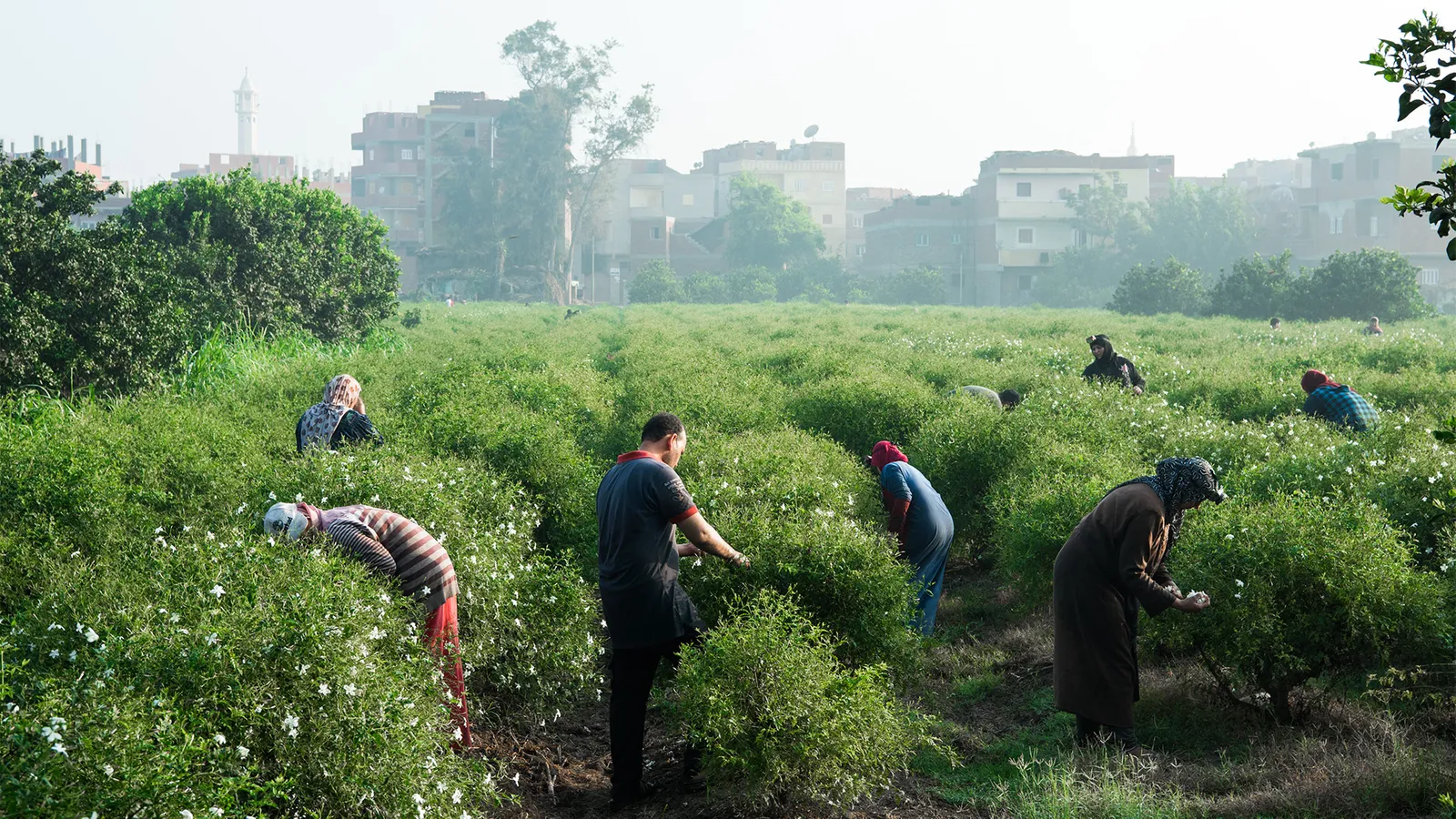
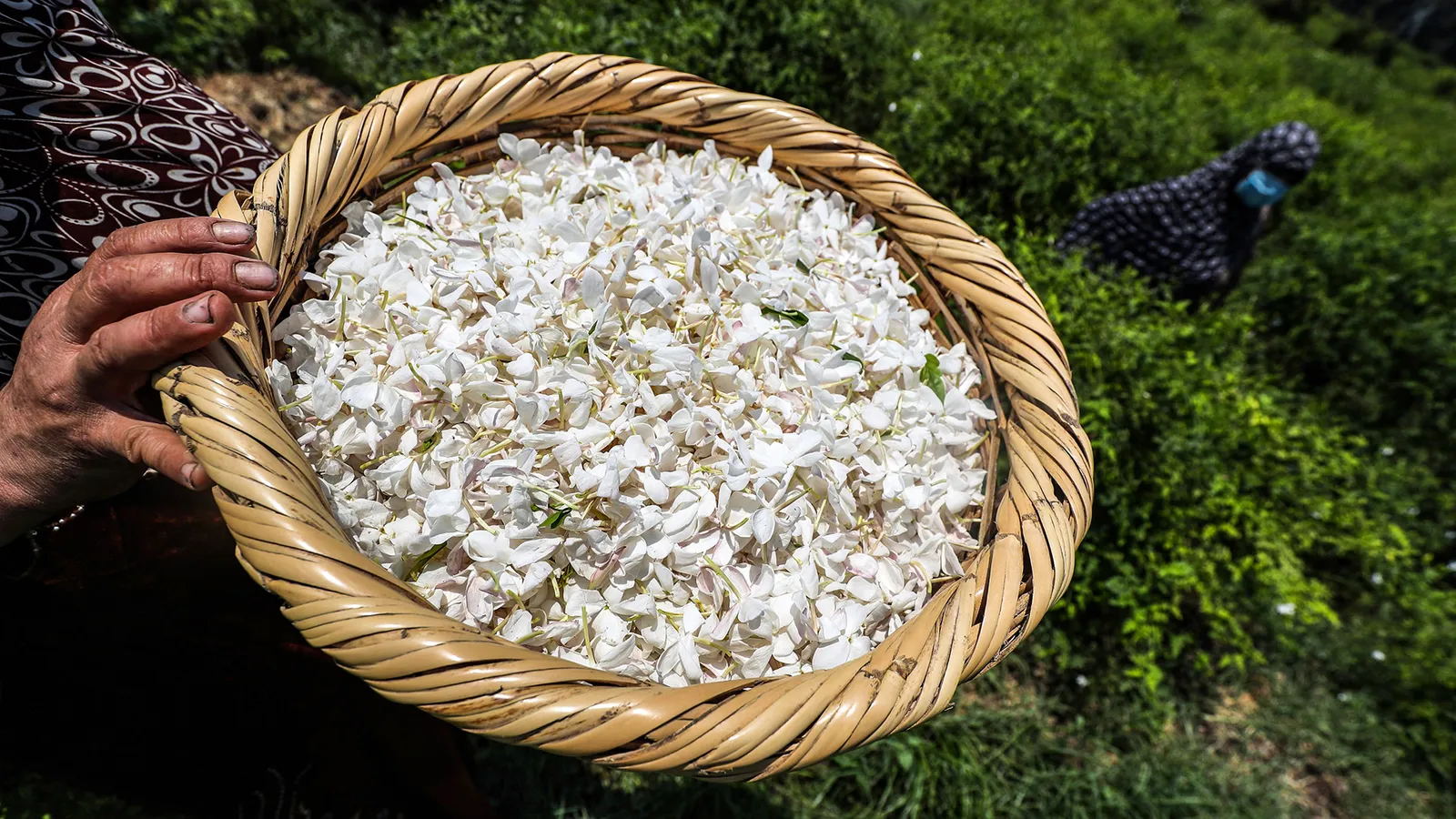
Jasmine blossoms must be picked carefully, one by one, to keep their oils. “When we are collecting, we need to balance between collecting quickly and at the same time not to press the flowers hard so they won’t lose their oils,” Faraj continued. “The best thing to do is to collect the mature white-coloured buds; they will still blossom anyway after being picked within a few hours.” The small, pink immature buds should be left for another day or two.
Blossom picking from the metre-high jasmine shrubs is laborious, and in many televised interviews, pickers have expressed their frustration about their wages. Faraj shares this frustration. “Jasmine picking is not financially rewarding for young men like me; we look for other better paying jobs. We pick jasmine all night and then we sell what we pick to the wholesale collector [who sends them to the factory] for 30 EGP [£1.44] for a kilogram of blossoms. A person picks an average of 3kg of blossoms making 90 EGP [£4.31] a day, which is little,” he explained.
The low price for picked blossoms can be attributed to competition with India, the second largest producer of jasmine after Egypt. Another reason, however, could be the complexity of extracting jasmine absolute – the substance used in perfumes – from the blossoms, which undergoes a two-step process: first, the blossoms are mixed with hexane, a colourless and odourless volatile petroleum derivative, to extract jasmine concrete, a butter-like intermediary product that contains both jasmine absolute and wax. Then, the jasmine absolute is separated from the wax using ethyl alcohol.
During this process, the weight of jasmine blossoms shrinks significantly. “To pick a kilo of blossom, a picker needs to collect between 4,000 and 6,000 individual blossoms,” Fakhry said. “I need one tonne of blossom – about 6 million blossoms – to produce about 2.6 or 2.7kg of jasmine concrete … and that concrete yields [1kg of jasmine absolute]”.
——
Despite the low wages, picking jasmine remains a main source of income for most of the villagers, especially women and the elderly, according to Faraj. “People here wait for the jasmine season to cover their big financial commitments – they plan their weddings based on the season,” he said.
However, as Shubra Beloula’s jasmine harvesting has started to get more national attention due to media coverage, tour groups have begun to visit the village, opening the door for other potential sources of income for villagers.
Many pickers love the presence of tourists .”We feel happy when people visit; they take pictures with us and we feel that our work is appreciated,” Faraj said.
Ashraf says that nature therapy, particularly connecting with plants, helps her boost her wellbeing, and that jasmine is particularly good for that. “Jasmine helps with mindfulness because of its smell, colour and texture,” she said.


